Designing Transit Documentation for Logistics Operations

Background
For any in-transit vehicle, shipment documentation is critical for compliance and smooth operations. This includes the invoice, E-Way Bill, and Lorry Receipt (LR), which collectively validate the movement of goods. A trip is considered successfully completed only upon submission of the electronic Proof of Delivery (e-POD), marking the final confirmation of delivery.
Current Practice
Till now, shipment documents were handled manually with no centralized system for sharing or tracking. The e-POD process was paper-based, requiring drivers to carry physical copies back to the transporter, who would then use them to raise invoices.
- High risk of document loss or damage
- Frequent disputes and verification issues
- Delayed invoice generation
Solution
Designed an end-to-end digital document and e-POD workflow integrated within the Taabi TMS.
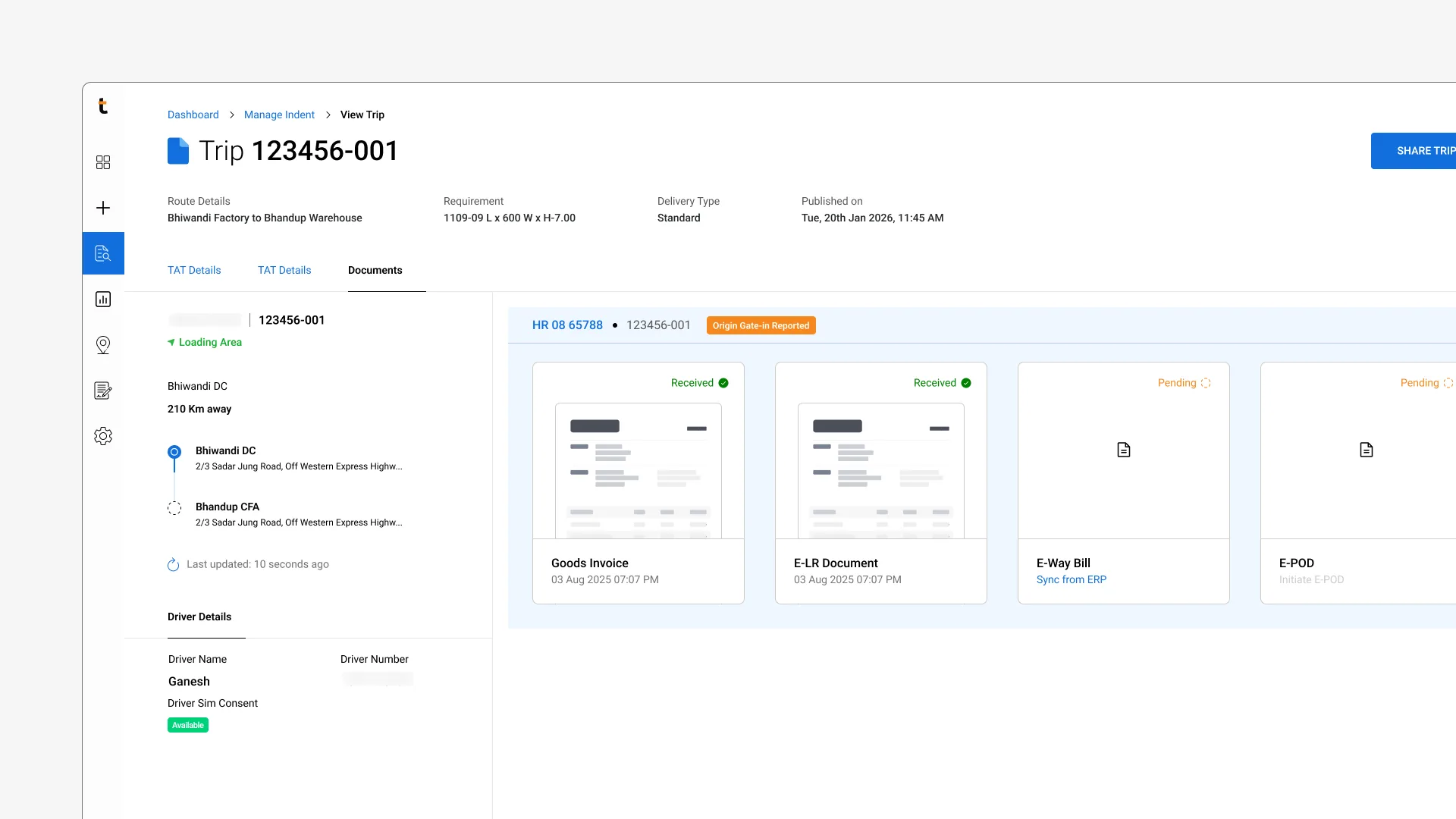
the designated area to store & view transit documents
Following is the list of features & flow I've designed to make the flow better
Digitization at Source01/04
Documents are attached to a trip as soon as the vehicle reaches the origin. With ERP integrations, key documents like invoice, and E-Way Bill, are automatically fetched, & E-LR gets generated, reducing manual effort and errors. All documents are stored in a unified space, making them easily accessible to all users.

documents accessible via side-sheet
Seamless e-POD Submission02/04
Enterprises can initiate e-POD requests through shareable links. The system supports both logged-in users (enterprise for transfers) and non-login users (end customers), ensuring broader usability. A mobile-first approach was adopted to make submission intuitive and efficient in on-ground conditions.

submit e-pod
To accommodate different operational scenarios, the e-POD sign-off process supports both OTP-based verification and simple acknowledgement-based confirmation.

dual sign-off methods
Dispute Resolution Workflow03/04
In case of discrepancies, disputed e-PODs are routed to the transporter for resolution. Both transporter and enterprise can either accept the claim or counter with revised amounts, supporting evidence (images), and reasoning. The system allows up to two negotiation cycles, after which the enterprise finalizes the settlement, ensuring a structured and transparent resolution process.

panel to discuss sku disputes
Invoice & Payment Closure04/04
Once the e-POD is resolved, the transporter can raise an invoice directly within the system. The enterprise can then accept or counter the invoice, maintaining consistency in the negotiation flow. The process concludes with the enterprise submitting proof of payment, marking the successful closure of the trip.


shots of trip invoice